Book 2 · The Technologies of the Awakened Mind
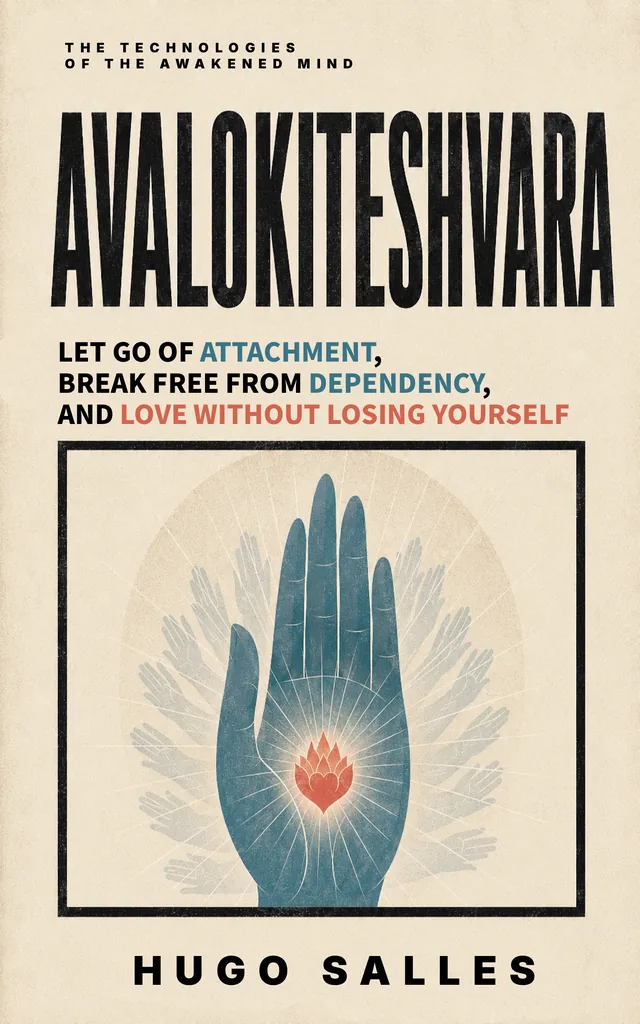
Avalokiteshvara
The jewel in the lotus — the Tibetan method to love without losing yourself and to turn attachment into compassion.
About the book
Attachment isn't only about people. It's about how the mind grips outcomes, identities and certainties — and refuses to let go.
Almost every piece of advice about attachment ends in the same place: let go. The trouble is that nobody explains how you release something the mind counts as part of itself. So the instruction evaporates in practice and what remains is guilt for failing to apply it.
Avalokiteshvara starts somewhere else. It maps a practical path for recognizing the grasping pattern in real time — mid-conversation, mid-wait for a reply, mid-decision that depends on someone else — and for responding with something more useful than resignation or control: compassion as a tool, not as a passive feeling.
The book works above all on the border between attachment and genuine care. They are two movements that look alike from the outside and operate in opposite ways from the inside: one tightens, the other holds. Showing where that line usually gets lost — in relationships, in projects, in the picture you keep of yourself — and how to recover it is the core work of this volume.
The figure of Avalokiteshvara enters here as method, not devotion. Tradition says his body shattered before the infinite suffering of the world: not from weakness, but from an excess of love with no channel to run through. It is an accurate description of what happens to anyone who cares without limit and calls it love.
Book details
Who this book is for
- Readers who love in a way that exhausts them — and suspect it isn't only love
- Anyone stuck waiting for an answer, a confirmation or someone else's approval
- Readers who confuse caring with controlling and want to see the difference in practice
- Anyone moving through the end of a relationship, a cycle or an identity
- Readers who want compassion treated as a trainable skill, not an abstract virtue
What you will find inside
- The operational difference between attachment and care — with signals for spotting each
- The myth of the thousand tears and what it describes about limits
- Practices for the moment the mind fuses with an outcome
- How to sustain affection without demanding a guarantee
- What compassion does when there is nothing to fix
Frequently asked questions
Does this book teach you to detach from people?
No. It works on the difference between attachment and care. The point is not to feel less, but to stop squeezing what cannot be held by squeezing.
Do I need to read Tara first?
No. Each volume in the series stands alone. If attachment, relationship or loss is what weighs most right now, this is the natural entry point.
Is it useful when a relationship is ending?
Yes. A large part of the book deals precisely with the period in which the mind keeps talking to someone who is no longer there.
Is it available on Kindle Unlimited?
Yes, the book can be read through Kindle Unlimited and is also available for individual purchase on Amazon.
Start reading today
Available in English and Portuguese, on Amazon and Kindle Unlimited.