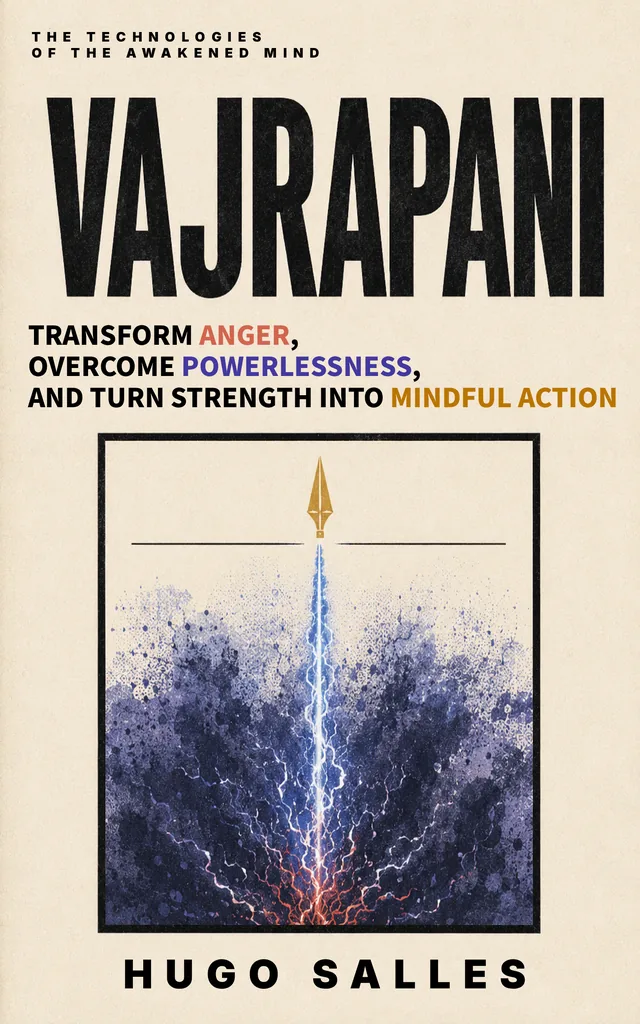
Book 5 · The Technologies of the Awakened Mind
Vajrapani
The Tibetan method for transforming anger, fear and powerlessness into conscious strength.
About the book
Strength isn't the opposite of gentleness. It's what gentleness does when it stops backing down.
We spend our lives swinging between two mistakes. Swallowing it — and turning it into resentment. Exploding — and turning it into regret. Neither resolves anything, and both teach the same wrong lesson: that anger is a defect to be eliminated.
Vajrapani teaches the third way: the strength that feels anger fully and channels it into conscious action. The book is about boundaries — how to set them without attacking, how to hold them when they are tested, how to protect your own truth without destroying anyone in the process.
The iconography helps carry the argument. The fangs, the fire, the skulls: none of it points outward, against enemies. It points inward, against the forces that hijack your freedom without your noticing — the fear that keeps you quiet, the pride that makes you attack, the laziness disguised as prudence, the confusion that convinces you it can't be done.
That is why this is not a book about anger. It is a book about power. Anger shows up often, because it is the raw material almost everyone wastes. But the subject, from beginning to end, is what to do with the strength living inside that material: how to take it back from the hands of fear, how to point it at the right place, and how to sustain it without becoming the thing you despise.
Book details
Who this book is for
- Readers who swallow the insult and discover the resentment weeks later
- Anyone who explodes and then spends days repairing the damage
- Readers who struggle to set and hold boundaries
- Anyone who feels powerless in front of a situation that won't move
- Readers who want to use anger as information rather than discharge
What you will find inside
- Why repressed anger doesn't disappear — where it goes instead
- Wrathful iconography read as a manual of conscious strength
- How to phrase a boundary so that it is actually heard
- What to do in the gap between trigger and reaction
- The practical difference between firmness and aggression
Frequently asked questions
Does the book argue that we should express anger?
Neither repress nor discharge. The book treats anger as energy carrying information: the work is reading what it points to and channeling the strength it brings.
Is Vajrapani useful for people who struggle with boundaries?
Yes. A large part of the volume deals with exactly that: phrasing, communicating and holding boundaries without aggression.
Do I need to read the earlier volumes?
No. Each book stands alone, though Vajrapani speaks closely to Tara, since fear and anger are often the same energy running in opposite directions.
Where can I buy it?
On Amazon US and Amazon Brazil, in English and Portuguese editions, with Kindle Unlimited reading available.
Start reading today
Available in English and Portuguese, on Amazon and Kindle Unlimited.