Book 3 · The Technologies of the Awakened Mind
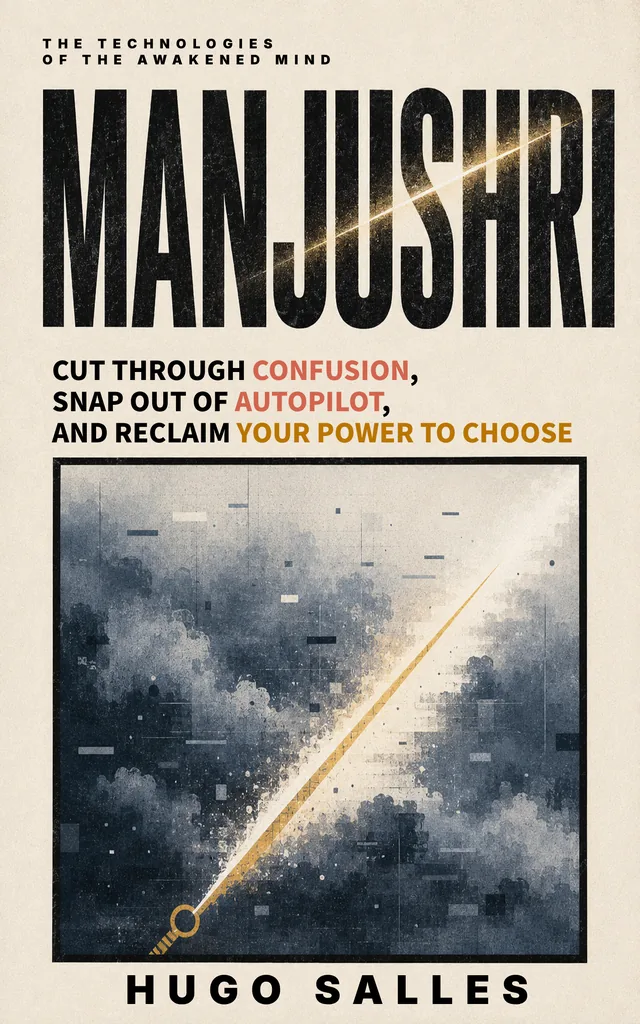
Manjushri
The sword of wisdom — the Tibetan method to cut through mental confusion and decide with clarity.
About the book
When small decisions become huge and thought spins in circles, the problem is rarely a lack of information. It is a lack of cutting.
There is a figure in the Tibetan tradition who holds no flower and offers no gesture of blessing. He holds a raised sword, wrapped in flame, ready to descend. The strangeness is fair: what is a weapon doing at the center of a tradition of peace? The answer fits in one sentence — there is a kind of suffering no amount of kindness resolves, because it is not made of pain, it is made of confusion. And confusion does not settle on its own. It has to be cut.
Manjushri develops the sword as method: the ability to separate the essential from the noise, to name what is actually at stake, to decide even under an excess of data or emotion. The book treats clarity as a trainable skill, not a rare gift some people have and others don't.
In practice, that means dismantling the mechanisms that manufacture fog: the endless research that substitutes for choosing, the pros-and-cons list that only postpones, the thinking that confuses intensity with importance, the habit of discussing the decision with everyone except yourself.
What the sword cuts is nobody. It is the invisible net of false stories, automatic reactions and inherited fears that clouds a life without you noticing — and which, once cut, reveals a question far smaller and far more solvable than it appeared.
Book details
Who this book is for
- Readers who research a decision for weeks and end up knowing less than when they started
- Anyone working under information overload who has to prioritize every day
- Readers whose mind feels scrambled and who can't name what is wrong
- Anyone who postpones choices out of fear of choosing badly
- Readers who want a criterion, not more opinions
What you will find inside
- Manjushri's sword read line by line as a description of method
- How to tell a hard decision apart from a badly framed one
- A cutting protocol for reducing a question to what actually matters
- Why more information, past a point, makes clarity worse
- Short practices for recovering focus inside the noise
Frequently asked questions
Is Manjushri a productivity book?
No. It deals with mental clarity and decision-making. There is a practical effect on focus and prioritization, but the subject is confusion, not time optimization.
Is it useful for people who struggle to decide?
Yes. A large part of the volume is devoted to chronic indecision: why it sets in and how to frame a choice so that it can finally be made.
Do I need to know Tibetan Buddhism?
No. Traditional elements are explained as they appear and always in service of the method.
Is it available on Kindle Unlimited?
Yes, alongside individual purchase on Amazon US and Amazon Brazil.
Start reading today
Available in English and Portuguese, on Amazon and Kindle Unlimited.